Impact Tech · Software · Mek-Tek
Klimokio
A personal carbon footprint tracker based on certified Life Cycle Assessment data: describe an action (a holiday, producing a product...) and get its full environmental impact, with the option to reliably offset. I created this with Claude Code.
Overview
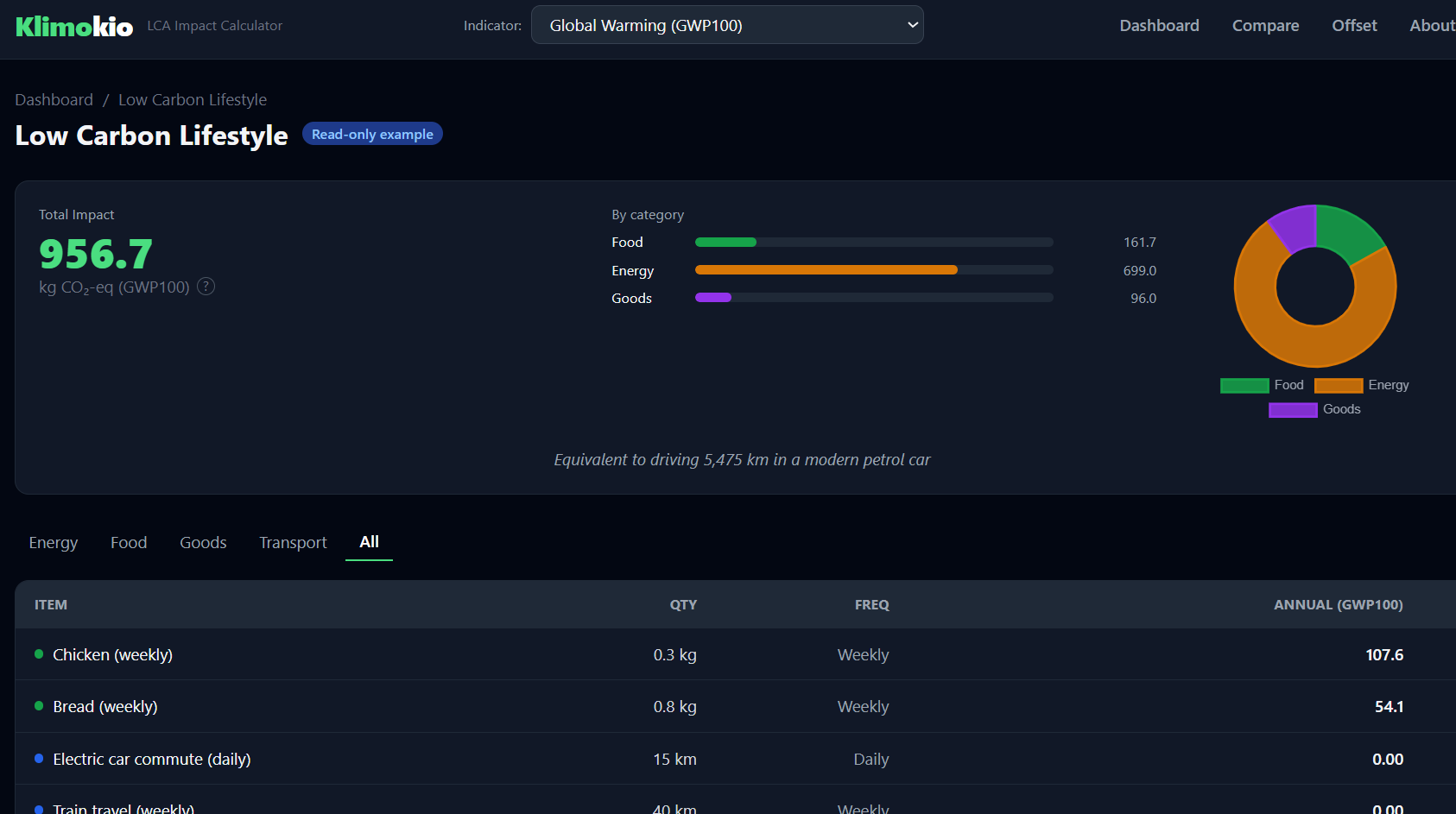
Klimokio is a full-stack web app that turns natural language descriptions of consumption (travel, production, electricity...) into verified, multi-indicator environmental impact data. The goal was to make Life Cycle Assessment (LCA) methodology accessible to individuals, with no spreadsheets and no manual lookups.
Users describe a choice; something they will consume, or a method of transport ("a flight from Berlin to London, then a drive to Edinburgh", "I eat 200g of beef twice a week"), and the app extracts structured items via AI, matches each one to an LCA factor database, and returns annual impacts across four environmental indicators. The live version is deployed at klimokio.com.
I built this to give environmentally motivated people easy access to the real data on impact, and offer them an opportunity to offset. This comes from the recognition that many personal sacrifices made in the name of the environment are carried out on little or incorrect data, and good data is a passion of mine.
How it works
- User inputs a free-text description of consumption, travel, energy use, or goods purchased
- Claude Haiku AI extracts structured items from the text, one per product, activity, or lifecycle stage
- Each item is matched to an impact factor in the database using full-text search (FTS5)
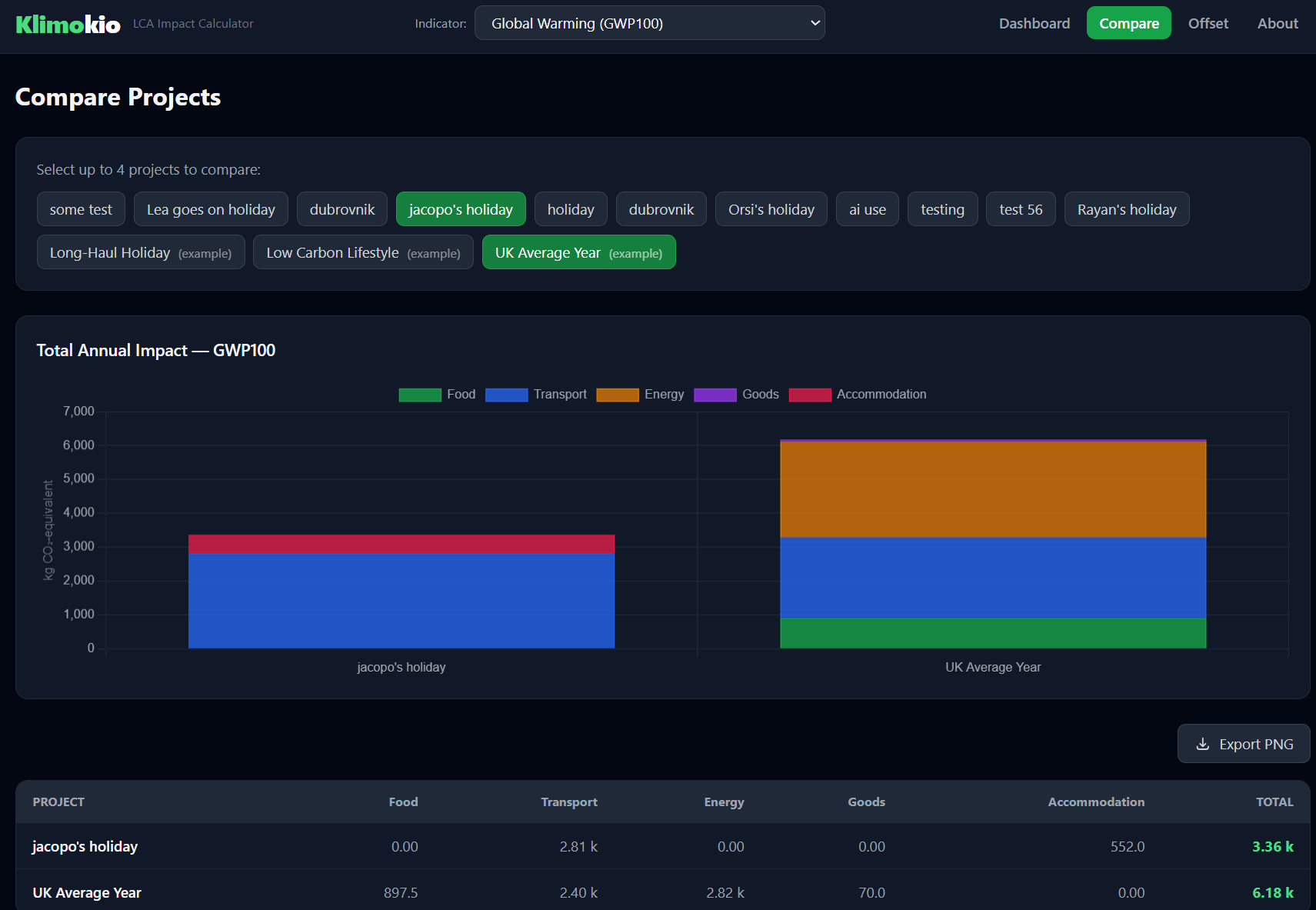
- Annual environmental impacts are calculated across four indicators and displayed with reliability ratings
- Projects can be saved locally in the browser or persisted server-side on Render
Environmental indicators
Most carbon calculators stop at CO₂. Klimokio tracks four indicators drawn from established LCA methodology:
- GWP100: Global Warming Potential (kg CO₂-eq), the standard carbon metric
- DALY: Disability-Adjusted Life Years, a human health impact measure
- Ecosystem Damage: impact on biodiversity and land use (species·yr)
- Resource Depletion: use of non-renewable resources (USD₂013-eq)
Each indicator is displayed alongside a reliability badge that is honest about where the data is strong and where it's an estimate. Where data is not available, the app says so rather than fabricating a proxy.
Data and AI design
The primary dataset is the UK government's DESNZ 2025 GHG Conversion Factors, covering transport, energy, food, accommodation, goods, and materials. The database covers 400+ impact factors, each with full lifecycle coverage where available.
The AI layer (Claude Haiku) splits lifecycle stages when a user mentions multiple phases (e.g. "production and disposal" becomes two separate items), uses precise material names for database matching ("Plastics: PP" not "PP plastic"), and defaults to conservative frequency assumptions. The prompt engineering was iterative, tuned against real user inputs to maximise match rates without hallucinating factors. The AI calls are also very energy efficient, with negligible environmental impact.
Deployment
The backend is FastAPI + SQLite, served via Uvicorn and deployed as a Render Web Service with
auto-deploy on git push. The frontend is a single-page Alpine.js + Tailwind CSS app. The domain
(klimokio.com) is registered via Cloudflare with a CNAME to Render, SSL via Let's Encrypt.
The impact factor database is managed via Google Sheets and synced to SQLite with a
custom sync_all.py script.